How Astronomy Shaped the Calendar We Use Today
The calendar used today is not simply a system of dates—it is the result of thousands of years of observation, calculation, and cultural adaptation. Long before modern science, early civilizations turned to the sky to understand time, tracking cycles of the Moon, the Sun, and the stars to organize daily life. These efforts gradually evolved into structured systems that governed agriculture, religion, and social order.
What began as simple observation became increasingly complex. Different cultures developed their own solutions to the challenge of aligning celestial cycles with human needs, often refining or correcting earlier systems. Over time, these overlapping traditions converged into the calendar now used globally, shaped by both scientific insight and political authority.
Be sure to check out tools to build your own custom calendars today!
Why Ancient Calendar-Making Began With the Sky
Long before written records, human societies relied on the sky as their primary reference for time. The regular movement of celestial bodies provided a natural rhythm that could be observed without tools or instruments. Early civilizations such as the Babylonians and Sumerians documented these patterns, linking them to seasonal changes and daily activities.
The sky was not simply a backdrop—it was a guide. Agricultural cycles depended on understanding when to plant and harvest, while religious rituals were often tied to lunar phases or solar events. Structures like Stonehenge demonstrate how carefully these patterns were studied, aligning architecture with solstices and equinoxes.
This reliance on the sky established a foundation for all future calendar systems. Timekeeping was inseparable from astronomy, and the need to interpret celestial movement drove the earliest developments in organized measurement.

How the Moon Became Humanity's First Calendar
Before written language, before agriculture, before the first cities rose from river valleys, our ancestors were already keeping time. They did it by watching the Moon. Carved stone tallymarks on animal bones from Dordogne, France, dating to 28,000 B.C., show 7 or 13 notches aligned with lunar cycles.
A cave in Thaïs recorded 29 notches matching one full Moon cycle. These weren't idle scratches — they were practical tools hunters carried across weeks-long expeditions tracking horses, bison, and mammoths. The Moon made sense as humanity's first calendar because it's predictable, visible, and rhythmic. Its phases guided ritual timing, shaped social gatherings, and eventually structured early agriculture.
Every ancient calendar system — Babylonian, Greek, Celtic, Roman — started with the Moon. Even the solar civic calendar of ancient Egypt showed traces of origin in an earlier lunar calendar, which continued to be used alongside the solar calendar for religious and agricultural purposes.
Why the Lunar Calendar Failed Farmers: and How Egypt Fixed It
The transition to agriculture exposed a fundamental flaw in lunar calendars. A lunar year is about 354 days long, falling short of the solar year by roughly 11 days. Over time, this difference caused seasons to drift, making it difficult to align planting and harvesting cycles with the calendar.
Egyptian civilization addressed this issue by shifting focus to the Sun. Around 2900 BCE, they developed a 365-day calendar based on solar patterns, particularly the heliacal rising of Sirius, which coincided with the annual flooding of the Nile. This system aligned more closely with agricultural needs.
The Egyptian calendar marked a significant turning point. By prioritizing solar cycles, it introduced a more stable framework for long-term planning, even though it still required refinement in later centuries.
How Greek Mathematicians Solved the Lunar-Solar Mismatch
Egypt's 365-day calendar solved the farming problem, but it left the lunar cycle behind entirely. Greek mathematicians tackled this gap head-on. Around 432 BCE, Meton of Athens noticed that 235 lunar months align almost perfectly with 19 solar years—totaling 6,940 days. His Metonic innovations gave Greek city-states a reliable intercalation system, inserting 7 extra months across that 19-year cycle.
But it wasn't perfect. In 330 BCE, Callippus of Cyzicus applied his Callippic refinement, linking four Metonic cycles minus one day into a 76-year period of 27,759 days. That correction reduced cumulative error to just one day every 424 years.
You can trace modern calendar precision directly back to these Greek breakthroughs, which turned astronomical observation into a working mathematical framework. Most Greek city-states operated on lunar-based calendars of approximately 354 days, divided into months classified as either Full or Hollow to reflect the natural lunar cycle.
Julius Caesar's Calendar Reform United the Roman World
While Greek mathematicians were refining lunar-solar cycles, Rome's calendar had collapsed into political chaos. By 46 BC, December fell in September, and priests manipulated dates for political gain. You can imagine festivals celebrated in completely wrong seasons, undermining civic order.
Caesar, as pontifex maximus, acted decisively. He enlisted Alexandrian astronomer Sosigenes, who calculated the solar year at 365.25 days. Caesar extended 46 BC to 445 days to realign the calendar, then standardized twelve months to 30 or 31 days, adding a leap year every four years.
The reform's genius lay in its reach. Imperial administration now operated on unified timekeeping, while provincial standardization replaced dozens of conflicting local calendars. This Julian calendar dominated the Western world for over 1,600 years. Conversion between the Julian calendar and various reformed local calendars was made practical through tabular aids called hemerologia.
Why the Julian Calendar Slowly Broke Down Over Centuries
Caesar's Julian calendar was a triumph of administrative will—but it carried a hidden flaw from the start. Roman priests made early leap day mistakes, inserting intercalary days every three years instead of four. That error alone added three extra days over 36 years before Augustus intervened.
But even after correction, a deeper problem remained. The Julian year averaged 365.25 days, while the actual tropical year measured 365.24219 days. That tiny gap—just 0.00781 days annually—sounds harmless, but you'd see its impact compound relentlessly.
By the 16th century, seasonal drift effects had pushed the calendar ten full days out of sync with the sun. Easter no longer fell in its proper season, and the vernal equinox wandered away from March 21. Reform had become unavoidable. Pope Gregory responded in 1582 by ordering the immediate removal of ten days and establishing a refined leap-year rule to prevent the drift from ever returning.
How Pope Gregory XIII Finally Corrected the Calendar in 1582
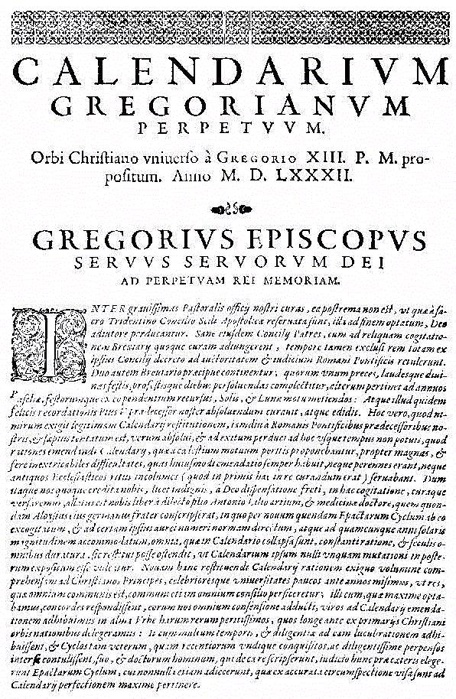
By the 16th century, the calendar's slow drift had become impossible to ignore, and Pope Gregory XIII stepped in to fix it. On 24 February 1582, he issued the papal bull Inter gravissimas, built on proposals by Luigi Lilio and refined by mathematician Christopher Clavius.
The reforms tackled both calendar politics and liturgical timing directly. Ten days were dropped — Thursday, 4 October 1582 jumped to Friday, 15 October — restoring the vernal equinox to March 21. Century years became leap years only if divisible by 400, tightening the average year to 365.2425 days.
You can trace today's Gregorian calendar directly to those changes. Catholic nations adopted it immediately, though Protestant and Orthodox churches resisted for decades before eventually following. The entire calendar cycle repeats every 400 years, spanning exactly 146,097 days and 20,871 weeks.
How Accurate Is the Gregorian Calendar: and Will It Ever Need Fixing?
The Gregorian calendar is remarkably accurate — it drifts just 27 seconds per year against the mean tropical year, meaning you'd wait roughly 3,030 years before it falls a full day behind astronomical reality. That's a dramatic improvement over the Julian calendar's one-day drift every 128 years. Still, no system's perfect.
Earth's slowing rotation and shifting equinoxes introduce long-term instability that no fixed rule fully captures, fueling ongoing leap second politics among astronomers and timekeeping bodies. The Revised Julian calendar actually outperforms the Gregorian, accumulating only two seconds of annual error. Divergence between the two won't matter until 2800.
Calendar culturalization means reform faces human resistance beyond mere mathematics — but astronomically speaking, you don't need to worry about fixing anything for another seven centuries. Century years divisible by 400 remain the cornerstone of the Gregorian leap year rule, a refinement that separates it from the simpler Julian system and accounts for much of its enduring precision.
Calendars, Culture, and the Organization of Everyday Life
Beyond its astronomical origins, the calendar has become a central part of cultural life. It structures work schedules, holidays, and social events, shaping how societies organize time. Religious observances, national celebrations, and global traditions all depend on shared systems of timekeeping.
Different cultures have adapted the calendar to reflect their own traditions. Lunar calendars remain important in many regions, particularly for religious purposes, demonstrating that multiple systems can coexist alongside the Gregorian standard. This cultural dimension highlights the calendar’s dual role. It is both a scientific tool and a social framework, linking celestial observation to everyday experience.
From Ancient Sky to Digital Timekeeping
Modern technology has transformed how calendars are used and experienced. Digital devices automatically track time, adjust for time zones, and synchronize global systems, making timekeeping more precise and accessible than ever before.
Despite these advancements, the underlying structure remains rooted in ancient astronomy. The divisions of months, years, and seasons still reflect patterns first observed thousands of years ago. This continuity demonstrates the lasting influence of early innovations. Even in a digital age, modern systems remain connected to the same celestial cycles that guided ancient civilizations.
Conclusion
The calendar used today represents a long history of observation, experimentation, and refinement. From early lunar tracking to advanced mathematical corrections, each stage reflects humanity’s effort to understand and organize time. This process reveals a balance between science and society. Calendars must align with astronomical reality, but they must also serve practical and cultural needs.
Their evolution reflects both precision and adaptation. Looking ahead, the calendar is unlikely to change dramatically, but its history continues to shape how time is experienced. It remains a reminder that even the most ordinary systems are built on centuries of human curiosity and ingenuity.