Houston’s Space City Legacy: What to See and Do
Houston’s identity as Space City comes to life at Space Center Houston, the official visitor center for NASA Johnson Space Center. A visit here gives you access to major exhibits, flown spacecraft, a real Moon rock you can touch, and NASA tram tours that take guests onto the Johnson Space Center campus.
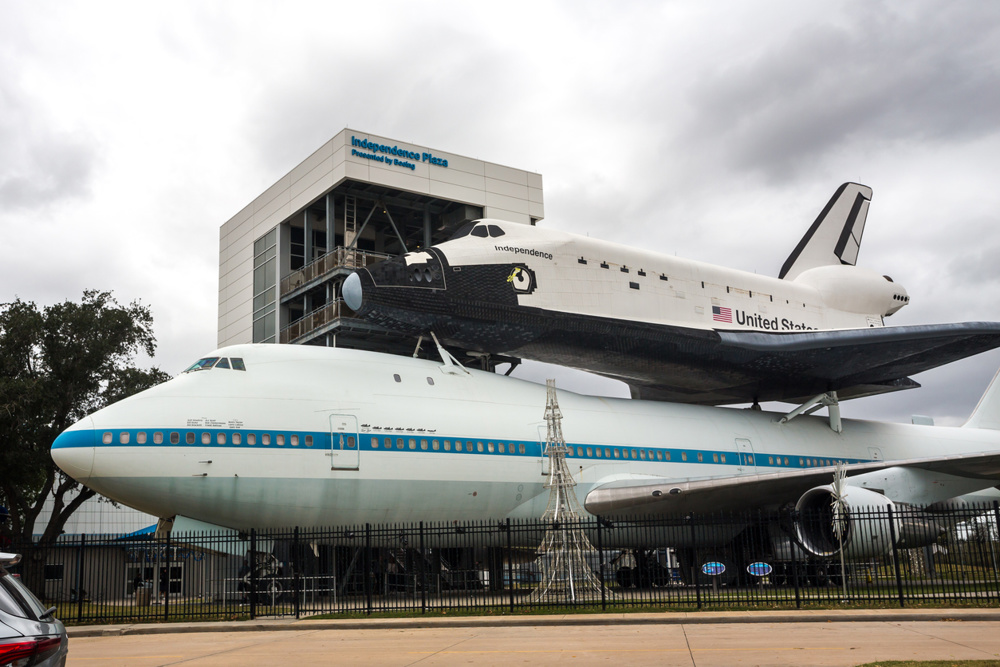
Visitors can also explore Independence Plaza, home to the shuttle replica Independence mounted on the original NASA 905 shuttle carrier aircraft, and Rocket Park, where the massive Saturn V rocket remains one of the site’s most memorable highlights.
General admission currently starts at $24.95, while a Mission Control Tour + General Admission package starts at $39.95. A separate NASA VIP Tour is available for $199.95 per person and includes general admission, but it is limited to guests 14 and older, with minors ages 14 to 17 required to attend with a paying adult. Parking is $10 plus a service fee, and some simulator experiences cost extra.
Rather than planning around fixed details that may change day to day, it is smarter to book early and check the current daily schedule before you go. Space Center Houston notes that tram tours are among its most popular experiences and that select tours can sell out well in advance.
What You Can Actually Do at Space Center Houston: Tours and Experiences
Space Center Houston offers a mix of self-guided exhibits and campus tours that make the history of human spaceflight feel immediate and tangible. The Starship Gallery is one of the center’s signature stops, with flown spacecraft and major artifacts including the Apollo 17 Command Module, a full-size Skylab trainer, and a Moon rock you can touch.
Another standout is Independence Plaza, where visitors can go inside the shuttle replica Independence and the original NASA 905 shuttle carrier aircraft. Space Center Houston describes it as the only shuttle mounted on the original NASA 905 aircraft.
Other core experiences include the International Space Station Gallery, which features flown station artifacts and interactive presentations, plus the Artemis Exhibit, which focuses on NASA’s return-to-the-Moon program. Mission Mars remains one of the center’s best-known interactive exhibits, though Space Center Houston currently notes that it is under renovation, so its availability may vary.
NASA tram tours are a major draw because they are the public’s route onto the 1,600-acre Johnson Space Center campus. Included tram experiences currently cover George W.S. Abbey Rocket Park, the Astronaut Training Facility, and the NASA Campus Tram Tour, while the Mission Control Tram Tour is sold separately.
NASA Tram Tours vs VIP Access: Which Experience Is Right for You?
For most visitors, the standard tram tours included with admission provide the best value. They cover major NASA points of interest and pair well with the museum exhibits inside Space Center Houston. The biggest limitation is that the Mission Control Tram Tour is not included with standard admission, so visitors who want that specific experience need to purchase it as an add-on package.
The NASA VIP Tour is geared toward guests who want a more exclusive experience. Space Center Houston says it is limited to 10 guests, uses private mini bus transportation, lasts about three hours, and includes access to areas not available on the general tram tour. It also includes general admission for the same day.
That means the decision mostly comes down to budget and depth. Standard admission works well for first-time visitors who want to see the major exhibits and campus highlights. The VIP option makes more sense for travelers who want a more guided, small-group visit with deeper behind-the-scenes access.
Space Center Houston Admission Prices: What Each Tour Level Costs
The most current pricing on Space Center Houston’s official site shows General Admission starting at $24.95 and Mission Control Tour + General Admission starting at $39.95. Special add-on experiences include Breakfast with an Astronaut + General Admission starting at $79.95 and the Early Access Tour + General Admission at $75.00.
The NASA VIP Tour is listed separately at $199.95 per person. Parking is $10 plus a service fee, and VR or motion simulators, when available, generally cost $8 to $10 per person and are not included in general admission.
Visitors can also save with Houston CityPASS, which Space Center Houston says offers up to 51% savings across participating attractions. Members receive free parking and no longer need to reserve a timed entry to visit.
Booking Your Visit: Age Requirements, Timing, and Advance Reservations
Space Center Houston recommends that guests arrive as early as possible during weekends, holidays, and summer, since those are peak attendance periods. Timed entry still matters for general admission, and the center advises visitors to align their entry window with the experiences they want most, especially tram tours.
Children 3 and under are admitted free on Space Center Houston ticketed events and promotions pages, and the center’s regular ticket packages vary by age. For the NASA VIP Tour, all participants must be 14 or older, and guests under 18 must be accompanied by a paying adult on the tour. Online VIP reservations must be made at least one day before the visit date.
A helpful planning note is that tram availability can change daily. Rather than relying on a fixed “last tram” time, check the daily schedule and reserve any special access experiences in advance. Space Center Houston specifically says popular tours often sell out far ahead of time.
Mission Control Tours: Walking Through Apollo Flight History
The Historic Mission Control Center is one of the most meaningful stops connected to Johnson Space Center. Space Center Houston states that this is the room in Building 30 where NASA monitored nine Gemini missions and all Apollo lunar missions, including Apollo 11 and Apollo 17. The restored room preserves the look and feel of the Apollo era, from consoles and monitors to the original layout used during the Moon missions.
This experience is not part of standard general admission. Space Center Houston says the tram tour to Historic Mission Control carries an additional cost and must be booked in advance when purchasing general admission online. Members receive 50% off this tour.
That makes this one of the best upgrades for visitors who care most about NASA history. If your main goal is to stand near the rooms associated with Apollo-era flight operations, this is the add-on that most directly delivers that experience.
Training Facilities You’ll See: Astronaut Prep Areas and NASA Campus Access
The public tram tours provide access to parts of the campus where astronauts train and where NASA continues its human spaceflight work. Space Center Houston lists the Astronaut Training Facility Tram Tour and NASA Campus Tram Tour among the included experiences with general admission.
One training facility often associated with Johnson Space Center is the Neutral Buoyancy Laboratory, part of the Sonny Carter Training Facility. NASA describes it as one of the world’s largest indoor pools, measuring 202 feet by 102 feet by 40 feet deep and holding 6.2 million gallons of water. The NBL is used for mission planning, hardware verification, and astronaut training for spacewalks.
That said, it is important not to overpromise public access. The original article implied that regular visitors or VIP guests are guaranteed tours inside the Neutral Buoyancy Laboratory, but Space Center Houston’s official public-facing tour pages do not promise that as a standard stop. It is more accurate to describe the NBL as a major Johnson Space Center training facility in Houston rather than a routine public tour guarantee.
The Saturn V Rocket, Moon Rocks, and Major Artifacts to See
One of the biggest visual highlights is the Saturn V rocket at George W.S. Abbey Rocket Park. Space Center Houston says the rocket stands 363 feet tall and is the only Saturn V made up entirely of flight-certified hardware. That distinction makes it especially significant compared with the other surviving Saturn V displays.
Inside the main visitor center, the Starship Gallery remains the best place to see flown spacecraft and historic artifacts up close. The gallery includes the Apollo 17 Command Module, the Mercury 9 “Faith 7” capsule, a Gemini V spacecraft, and the Skylab 1-G Trainer. It also includes the Lunar Samples Vault, which Space Center Houston describes as the largest display of Moon rocks on public display in the world.
The broader center contains more than 400 spaceflight artifacts and exhibits, according to Space Center Houston’s VIP tour information. That makes the site much more than a single museum stop. It is a large, layered collection of exhibits that can easily fill most of a day.
Johnson Space Center Virtual Tours (If You Can’t Visit Houston)
If you cannot make it to Houston, NASA offers Johnson Space Center virtual tours online. NASA’s official Johnson virtual tours page includes destinations such as Ellington Field, which supports astronaut training and other flight operations. NASA also highlights Johnson’s virtual experiences through its broader NASA at Home resources.
Space Center Houston also offers digital resources, including its interactive mobile tour and online educational content. These options are not a replacement for seeing the full site in person, but they are useful ways to explore some of Houston’s space legacy remotely.